
Ever wondered why your engine isn’t running as smoothly as it should? You’re not alone. Many car enthusiasts face the challenge of tuning a carburetor for optimal performance. A vacuum gauge can be a game changer in this process, helping you pinpoint issues that might be holding your ride back.
Key Takeaways
- Carburetor Functionality: Understanding the role of carburetors in mixing air and fuel is essential for optimizing engine performance and efficiency.
- Different Types of Carburetors: Knowledge of various carburetor types—constant-pressure, variable-pressure, single-barrel, multi-barrel, downdraft, and side-draft—can aid in selecting the right one for your vehicle’s needs.
- Benefits of Proper Tuning: Regular tuning enhances fuel efficiency, engine performance, idle quality, and helps reduce harmful emissions while preventing costly repairs.
- Vacuum Gauge Usage: A vacuum gauge is a critical tool for assessing air-fuel mixtures in a carburetor, providing valuable feedback for making necessary tune adjustments.
- Steps for Effective Tuning: Follow a systematic approach involving tool preparation, vacuum gauge setup, idle mixture adjustments, and final performance tests to achieve optimal tuning results.
Understanding Carburetors
Carburetors play a crucial role in the engine’s performance. They mix air and fuel in the right ratios, ensuring efficient combustion.
What Is a Carburetor?
A carburetor is a device that blends air and fuel for an internal combustion engine. It regulates the flow of these components, allowing engines to maintain optimal performance. The mechanical parts within a carburetor include jets, floats, and valves. Each part contributes to creating the right fuel-air mixture necessary for combustion.
- Constant-Pressure Carburetors:
- Constant pressure carburetors maintain a steady air-fuel mix regardless of engine load. They’re often found in racing applications for their high efficiency.
- Variable-Pressure Carburetors:
- Variable pressure carburetors adjust fuel delivery based on engine demands. These are common in street vehicles, providing a balance between performance and fuel economy.
- Single-Barrel Carburetors:
- Single-barrel carburetors feature one throttle opening. They’re straightforward and ideal for smaller engines, minimizing complexity and weight.
- Multi-Barrel Carburetors:
- Multi-barrel carburetors, with two or more barrel openings, deliver more fuel and air, enhancing performance for larger engines. They’re popular in muscle cars and high-performance vehicles.
- Downdraft Carburetors:
- Downdraft carburetors draw air down through the carburetor into the intake manifold. Their design supports high performance at various RPMs.
- Side-Draft Carburetors:
- Side-draft carburetors pull air horizontally, making them suitable for racing and performance applications. They allow for better induction paths in some engine setups.
By understanding the different types of carburetors, you can choose one that best fits your application and tuning needs.
The Importance of Tuning
Tuning a carburetor significantly impacts your engine’s performance. It ensures optimal air and fuel mixtures for effective combustion, enhancing efficiency and power.
Recommended Products
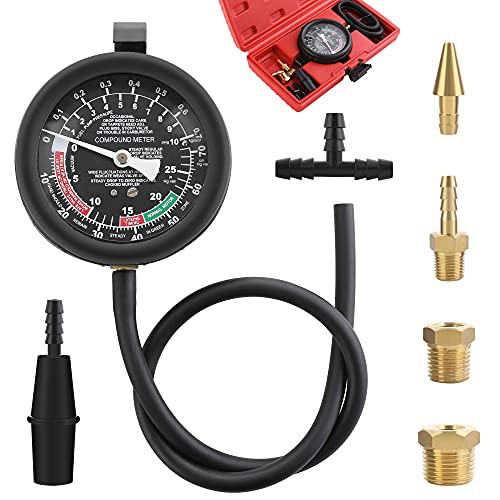
FUEL PUMP - This pressure gauge set can be used to test fuel pump pressure, emission control devices, leaky, stuck open or burnt valves. Clogged muffler, turbo or exhaust system. Helps to locate leaks in the gas line, valve timing, worn out rings and seals, heating and air conditioning components.

Professional Fuel Pump Pressure & Vacuum Tester Kit: This comprehensive kit is designed for testing fuel delivery pressure to the engine, making it an essential tool for diagnosing worn or defective parts. It is also highly effective in diagnosing various engine issues such as leaking valves, incorrect timing, leaky intake manifolds, and clogged mufflers.

Professional Vacuum and Fuel Pump Tester Kit: Fuel Pump Pressure & Vacuum Tester Gauge Kit, Carburetor Test enables testing of the fuel delivery pressure to the engine to check for worn or defective parts; Diagnose leaking valves, incorrect timing, leaky intake manifolds, and clogged mufflers. Fuel pump operating pressures up to 10 PSI (0.7 Bar), Pressure gauge 0-28 IN-Hg (0-70 cm-HG) vacuum and 0-10 PSI (0-0.7 kg/cm²) pressure
Benefits of Proper Tuning
- Improved Fuel Efficiency: A well-tuned carburetor maximizes fuel usage, leading to better mileage and reduced costs at the pump.
- Enhanced Engine Performance: Tuning allows your engine to generate more horsepower and torque, resulting in a smoother, more responsive drive.
- Reduced Emissions: Proper adjustments help minimize harmful emissions, contributing to a cleaner environment.
- Consistent Idle Quality: A correctly tuned carburetor ensures your engine idles smoothly, reducing vibrations and improving overall driving experience.
- Prevention of Engine Issues: Regular tuning can identify potential problems early, preventing costly repairs and extending your engine’s lifespan.
- Rough Idle: An irregular idle indicates a lean or rich fuel mixture requiring immediate tuning adjustments.
- Backfiring or Stalling: These issues often point to tuning problems, as they disrupt the proper air-fuel ratio.
- Poor Acceleration: If your vehicle hesitates or lacks power when accelerating, it could stem from improper tuning.
- Increased Fuel Consumption: A sudden drop in fuel efficiency usually signals a problem, often related to carburetor settings.
- Unusual Engine Noises: Odd sounds, such as knocking or pinging, often signal tuning issues needing attention.
Using a Vacuum Gauge
A vacuum gauge helps you analyze the air mixture in your carburetor. Proper tuning enhances engine performance, fuel efficiency, and overall reliability.
Recommended Products

[PRESSURE GAUGE]: Test fuel pump output pressure to 10PSI. Read engine vacuum to 28" HG.

Function: The fuel pump pressure & vacuum tester kit enables testing of the fuel delivery pressure to the engine to check for worn or defective parts in fuel pumps and vacuum systems.

【Applicable】This Alltooetools vacuum carburetor synchronization balancer gauge carb synchronizer adjustment tool kit is designed for Gs Kz 550 650 750, however, can also be used for most standard 2 to 4 carburetor systems and works on your motorcycle, race car, and auto A/C vacuum motor; This carb tuner synchronizer tool can even help to regulate your fuel pressure.
What Is a Vacuum Gauge?
A vacuum gauge measures the negative pressure within the intake manifold. It provides critical insights into your engine’s air-fuel mixture. By monitoring this pressure, you can identify potential problems and make necessary adjustments. Additionally, different readings indicate various engine conditions, making the vacuum gauge an essential tool for tuning carburetors.
How to Read a Vacuum Gauge
Reading a vacuum gauge involves a few straightforward steps:
- Connect the Gauge: Attach the gauge to a vacuum port on the intake manifold. Ensure a secure fit to avoid leaks.
- Start the Engine: With the gauge connected, start the engine and allow it to idle. The gauge will display the current vacuum level in inches of mercury (inHg).
- Understand the Reading:
- Normal Range: Most engines idle between 17 and 22 inHg. If your reading falls within this range, your carburetor functions correctly.
- Low Reading: A reading below 17 inHg could indicate a rich mixture or potential leaks in the vacuum system.
- High Reading: A reading above 22 inHg may suggest a lean mixture or restricted airflow.
- Adjust Accordingly: If your reading isn’t optimal:
- Lower the float level for a rich condition.
- Adjust the air-fuel mixture screws for a lean condition.
- Recheck the Gauge: After adjustments, recheck the vacuum gauge. Aim for the ideal reading during different engine speeds, including idle and acceleration.
Using a vacuum gauge simplifies the tuning process, giving you direct feedback on the carburetor’s performance.
Steps to Tune a Carburetor with a Vacuum Gauge
Tuning a carburetor with a vacuum gauge involves a series of straightforward steps. Follow these steps carefully to optimize your engine’s performance.
Recommended Products
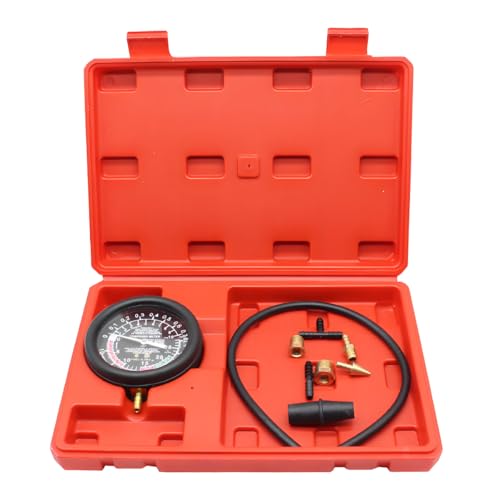
【Practical Functions】: The vacuum pressure gauge set accurately tests fuel pump pressure, quickly detects leaks in fuel systems and vacuum lines, and evaluates the status of emission control devices, valves, mufflers, or exhaust systems. It helps troubleshoot leaks in gas pipelines, valve timing, worn piston rings, and seals, as well as heating and air conditioning components.

Helps to identify and diagnose system vacuum leaks and problems in the engine and the various vacuum-operated motors and accessories
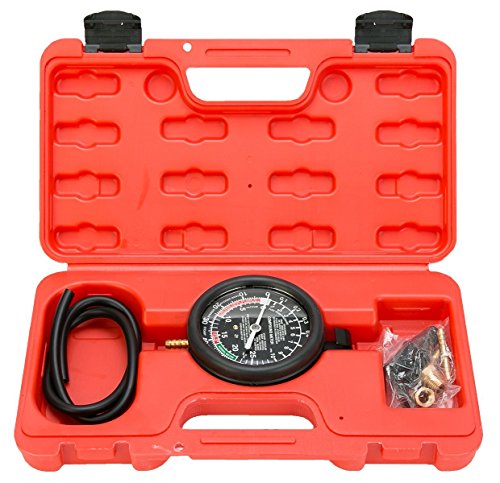
Test fuel pump output pressure to 10PSI
Preparing Your Tools
Gather the following tools before you begin:
- Vacuum Gauge: Essential for measuring manifold pressure.
- Wrench Set: Needed for loosen and tighten adjustments.
- Screwdriver: Helps in adjusting the idle mixture screws.
- Shop Manual: Provides specific adjustment details for your engine type.
Make sure you’ve arranged a clean workspace. Having all tools within reach streamlines the tuning process.
Setting Up the Vacuum Gauge
- Locate the Vacuum Source: Identify a port on the intake manifold where you’ll attach the gauge. Avoid ports for accessories like power brakes.
- Connect the Gauge: Use a rubber hose to connect the vacuum gauge to the chosen port. Ensure the connection is tight to prevent leaks.
- Start the Engine: Start your engine and let it idle. Watch the vacuum gauge for steady readings.
A stable reading indicates a properly running engine. If the gauge fluctuates significantly, check for vacuum leaks.
Adjusting the Idle Mixture
- Identify the Idle Mixture Screws: Locate the mixture screws. Usually, you’ll find one for each barrel on the carburetor.
- Turn the Screws: Slowly turn each screw clockwise until it lightly seats. Then, turn it counterclockwise 1.5 to 2 turns as a starting point.
- Check the Vacuum Gauge: Monitor the gauge reading as you make adjustments. Ideally, you want to achieve the highest vacuum reading possible.
Fine-tune each screw slowly to avoid overshooting the ideal mixture.
- Increase Engine Speed: Gradually rev the engine above idle and note changes in the vacuum reading.
- Adjust Mixture as Needed: If the reading drops when you increase speed, enrich the mixture by turning the screws counterclockwise slightly.
- Final Tests: Perform tests at various engine loads. Check how the vacuum behaves under acceleration and cruising conditions.
Making sure the engine runs smoothly at different speeds means you’ve achieved a well-tuned carburetor. Adjust as necessary to keep performance optimal.
By following these steps, you can effectively tune your carburetor, enhance engine performance, and improve fuel efficiency.
Conclusion
Tuning your carburetor with a vacuum gauge can make a world of difference in your engine’s performance. By taking the time to follow the steps outlined you’ll not only enhance efficiency but also enjoy a smoother ride.
Remember that fine-tuning is an ongoing process. Don’t hesitate to make adjustments as needed based on your driving conditions. With a little patience and practice you’ll become more confident in your tuning skills.
So grab your tools and get started. Your engine will thank you for it!
Frequently Asked Questions
What is a carburetor, and why is it important for engine performance?
A carburetor is a device that mixes air and fuel for combustion in an engine. It plays a crucial role in optimizing engine performance by ensuring a balanced air-fuel mixture, which enhances power generation and efficiency.
How do I know what type of carburetor my engine needs?
The type of carburetor needed depends on the engine specifications, use case, and performance goals. It’s essential to consider factors like engine size, horsepower requirements, and whether the vehicle is for street or racing applications.
What is a vacuum gauge, and how is it used for carburetors?
A vacuum gauge measures the engine’s manifold vacuum, helping diagnose carburetor performance issues. By analyzing vacuum readings, you can adjust the carburetor settings to achieve the desired air-fuel mixture for optimal performance.
How do I tune a carburetor using a vacuum gauge?
To tune a carburetor with a vacuum gauge, gather necessary tools, set up the gauge, adjust the idle mixture screws, monitor vacuum readings, and fine-tune the settings for different engine speeds. This process enhances performance and fuel efficiency.
What are the benefits of tuning a carburetor?
Tuning a carburetor improves engine response, enhances power output, and optimizes fuel efficiency. It ensures the engine runs smoothly across various conditions, leading to a longer lifespan and better overall performance.
How often should I tune my carburetor?
It’s recommended to tune your carburetor at least once a year or whenever you notice changes in engine performance, fuel economy, or if modifications are made to the engine. Regular checks help maintain optimal function.
